 -
Centre for Education & Documentation
-
Centre for Education & Documentation
|
|
By and large, however, employer/employee relations are determined by
direct collective bargaining.
Most of the acts passed by the Government for the welfare of workers
relate to the workers in the 'organized
sector' of India's economy. A number of social security schemes have been
established
for them as well. Some acts and rules have also been framed for the non-organized
sector.
|
|
Origins (Before 1840)Early Industria1isation ( 1840-1900) : Emergency of Indian Working Class
Working Class Movement in India
First Phase ( l850-19QQ)
Second Phase (1900-1914)
Third Phase (1915-1922)
Fourth Phase (1923-1939)
Fifth Phase (1940-1947)
Sixth Phase (Post Independence )The Current. Reality
Major Labour Struggles in 1920
|
|
| SECOND NATIONAL COMMISSION ON LABOUR |
The need for setting up of the Second National Commission on Labour had been felt for the following reasons :-
i)
...there has been an increase in number of labour force etc.because of
the pace
of industrialisation and urbanisation.
ii)....
in the economic environment of the country which have in turn brought about
radical changes in the domestic industrial climate and labour market.
iii)
Changes have occurred at the work places, changes in the industry and character
of employment, changes in hours of work and overall change in the scenario
of
industrial relations.These changes have resulted in certain uncertainties
in the
labour market requiring a new look to the labour laws.
PART-II (UN-ORGANISED
SECTOR)
|
|
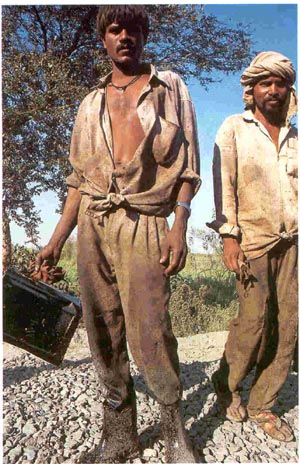
Unorganised Sector Workers and producers include agricultural labourers, small and marginal farmers, forest workers, fishersfolk, beedi rollers, garmemt stitchers, construction workers, ragpickers - people involved in an innumerable variety of tasks and employments. Having no fixed employer, these workers are casual, contractual, migrant, home-based, own-account workers who attempt to earn a living from whatever meagre assets and skills they possess. |
|
|
On June 1, 1998, at its 86th session in Geneva, the International Labour Conference adopted a "Declaration on Fundamental Principles and Rights at Work". Article 2 of this document declares, "...that all members, even if they have not ratified the Convention in question, have an obligation arising from the very factr of membership in the Organisation, to respect, to promote and to realise, in good faith and in accordance with the Constitution, the Principles concerning the fundamental rights which are the subject of the Conventions, namely: a) Freedom of association and the effective recognition of the right to collective bargaining; b) The elimination of all forms of forced or compulsory labour; c) The effective abolition of Child labour; and d) The elimiation of discrimination in respect of employment and occupation".
ARTICLES
ON LABOUR & RELATED ISSUES
SOME
OF THE GREAT LABOUR STRUGGLES OF THE CENTURY
-
BOMBAY TEXTILE WORKERS STRIKE(1928)
-
TISCO WORKERS STRIKE(1928)
- TELAGANA ARMED STRUGGLE(1946-51)
-
TEBHAGA STRUGGLE OF BENGAL(1946-47)
-
THE ROYAL INDIA NAVY STRIKE (1946)
-
RAILWAY WORKERS STRIKE (1974)
-
MUMBAI TEXTILE WORKERS' STRIKE(1985)
-
KAMANI WORKERS' STRIKE (1985)
-
PORT AND DOCK WORKERS STRIKE (1989)
-
FISHWORKERS STRUGGLE (1994)