 In
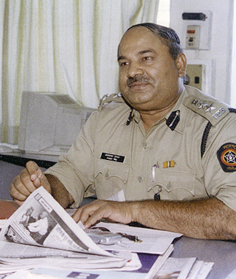
the dock: Mumbai Anti-Narcotics Cell DCP Jawahar Singh
In
the dock: Mumbai Anti-Narcotics Cell DCP Jawahar Singh
|
uVishaka
vs State of Rajasthan
|
COVER STORY
The Week Study
Cases of sexual harassment are on the increase,
By Nistula Hebbar |
 Year
2002. An India proud of its growth and development, and gung-ho
about the all-new image of the emancipated and empowered Indian woman.
An 'empowered Indian woman' sexually harassed at the workplace! Take the
case of Dr Meeta Patil* of Cama and Albless Hospital in Mumbai. On her
way to the hospital on March 13, Dr Santosh Pawar, her senior, made a grab
at her. She broke free and ran but Pawar and two friends gave chase and
threatened her with dire consequences if she reported the assault.
Year
2002. An India proud of its growth and development, and gung-ho
about the all-new image of the emancipated and empowered Indian woman.
An 'empowered Indian woman' sexually harassed at the workplace! Take the
case of Dr Meeta Patil* of Cama and Albless Hospital in Mumbai. On her
way to the hospital on March 13, Dr Santosh Pawar, her senior, made a grab
at her. She broke free and ran but Pawar and two friends gave chase and
threatened her with dire consequences if she reported the assault.
In most cases women feel raped-psychologically. They go through post-rape trauma-a drop in self-esteem and confidence
In her complaint to the police, the just-married Meeta said Pawar had been "bothering" her for nearly six months. "He used to call her regularly on her mobile, once making her weep in the ward," said a hospital employee. Her husband and parents had tried to make him behave well and, following her complaint, Pawar was arrested on March 15 but bailed out later. Dr Meeta, meanwhile, has been transferred to J.J. Hospital on request.
Rashmi Modak, a newly wed receptionist in a small software firm in Delhi, too had to suffer advances by her superior in an office environment that took scant notice of the Supreme Court guidelines (1997) to prevent sexual harassment in the workplace. Sexual innuendoes and frequent offers of "office-sponsored trips" out of town pushed her to the verge of resigning. Her husband, although not unsympathetic, wanted her to quit. "He said there must have been something in my behaviour that evoked such a response," she said. Rashmi eventually joined another organisation, at a lower pay and farther away from home.
The sexual harassment helpline Madhyam in Delhi, run by the Socio-Legal Advice Centre, gets about 35 calls a month and helps file three or four cases. Ripple Yadav, in charge of the helpline, said most calls were from the private sector. "Many of these new software firms do not have a clue about sexual harassment guidelines," she said. Not that government offices offer immunity from sexual predators. But women in the private sector are more vulnerable to harassment because of less job security.
Even top government officers have complained of sexual harassment. IAS officer Nalini Netto, 42, accused a minister, Neelalohithadasan Nadar, of making sexual advances towards her in his office on December 21, 1999. The case is still pending. A judicial commission insisted on recording her evidence in public, opposed to the Supreme Court guidelines for in camera proceedings. She refused to appear before the commission and moved the Supreme Court, which stayed the inquiry. Its term soon ran out. Nadar, who has filed a review petition in the High Court, is also accused of sexually harassing Forest Service officer Prakriti Srivastava. Nalini has unstinting support from her husband, Desmond Netto, an IPS officer. On a two-year leave from service, she is pursuing a doctorate at Jawaharlal Nehru University, New Delhi.
Sexual harassment cases are often considered the exaggerated reactions of oversensitive women to 'normal male flirting'. In truth, it is a social problem and also the employers' as it leads to absenteeism, lower productivity, and damages to victims in case of law suits.
Lawyer Aparna Bhatt, head of the Socio-Legal Advice Centre, said the management often supported the perpetrator. In an infamous case at the Faridabad branch of the Delhi Public School, the teachers filed a statement on behalf of the principal U.S. Verma who had allegedly harassed two teachers and a receptionist into leaving their jobs.
In
the dock: Mumbai Anti-Narcotics Cell DCP Jawahar Singh
Archana Rawat, who worked in an export house, had the same experience. "When I sent a legal notice to the management about my supervisor harassing me, they supported him," she said. "All the female employees were made to testify that I was exaggerating and to vouch for his character." At such times the victim badly needs psychological 'hand-holding'. "Once a woman complains, she becomes a victim several times over," says Ripple Yadav.
The long arm of the law isn't innocent, either. A harried assistant sub-inspector in the Delhi Police recently had a tough time when she tried to register a case of sexual harassment. "If it can happen to me, a policewoman, it can happen to anyone," she said. Neelam Bhagat, a sub-inspector in Mumbai, was transferred out of the high profile Anti-Narcotics Cell on March 18 after she complained of sexual harassment by her boss, Deputy Commissioner of Police Jawahar Singh. Bhagat alleged that Singh had called her to his office on March 2 and made passes at her.
On March 7, she-along with husband Shashikant-went to meet then joint commissioner of police B.Y. Mohite. Following his instructions, she filed a complaint against Singh on March 11. Singh told The Week that the allegations were part of a conspiracy to malign him. "Bhagat and some others were running a squad that collected money in my name ever since I joined here in October 2001," he said. "I found out about the squad in February and transferred her to the Worli unit of the cell along with some other officers. I issued the order on February 15 and I have a copy of it. Why did she come here on March 2 when she was posted at Worli?"
Singh asked why Bhagat had met Mohite only five days after the alleged incident. He also said Mohite had denied him permission to speak to the media. Activist Amu Abraham of the Women's Centre, an NGO, said the Mumbai Police did not send out the right signals by transferring Bhagat out of the Anti-Narcotics Cell. "The Supreme Court had issued a guideline long ago that working women who complain of sexual harassment by their seniors at work should not be discouraged, transferred or demoted," she said.
The National Commission for Women (NCW) has devised a gender sensitisation curriculum for government servants, the police, media and the judiciary. "The media-with irregular working hours and the purely subjective criterion for evaluating performance-is particularly bad when it comes to a sexually charged workplace," said Reva Nayyar, member secretary of the NCW.
In most cases women feel raped-psychologically. They go through post-rape trauma-a drop in self-esteem and confidence, nervousness, humiliation, and guilt that they were somehow 'responsible'. Scandals about the victim's character often misrepresent her as the wrongdoer. Fearing such an outcome, women often cringe from speaking out against their tormentors. And for most, the episode usually results in their giving up the job-either quietly or under protest. Fear of unemployment also leads to women enduring the misery.
Under-performance is a frequent excuse used to persecute a woman employee who rebuffs sexual advances. Mini Kapoor*, a nurse at the Lala Ram Swaroop Tuberculosis Hospital, Mehrauli, complained of harassment by the director V.K. Arora. When the health ministry offered to take her off night duty, Arora said that she had been found napping on duty and that the union had put her up to complain. He alleged that the Supreme Court guidelines on sexual harassment were "being misused to malign" him.
A major reason that inhibits reporting of sexual harassment cases is that evidence is very difficult to gather. Said Modak: "The remarks were made only when the two of us were present. There was no way to prove that the events I have described actually happened." In such cases, legal advisers look at past and present performance appraisals to determine patterns of victimisation. Any memo or handwritten notes and letters reflecting a less-than-professional approach are also admissible in court. Settlements offered by the management are often loaded in favour of the perpetrators.
An NCW study of government offices found that 60 per cent of working women were not aware of the Supreme Court guidelines. Nearly 50 per cent of the offices had not put up the guidelines on notice boards as directed by the court and did not have complaints committees either. Which explains why women's activists are calling for legislation on sexual harassment. "We need a law that will scare the perpetrators," said Nayyar.
However, a schism seems to have appeared within the women's movement
with organisations like Sakshi (which fought the Vishaka case leading to
the Supreme Court setting down the guidelines) and Lawyers Collective saying
that the guidelines will suffice. " With another law, the government will
just sit back and say they have done enough," said Leena of Madhyam.
A women's rights activist once jokingly told a judge in Ahmedabad:
"Sexual harassment is like God; it's everywhere." Ethereal similes apart,
the fact remains that for all the silence maintained on the issue, even
one lone voice is enough to call the bluff. Women's organisations are hoping
that their efforts would result in just that.
* Name changed to ensure privacy
With Dnyanesh Jathar and Vinu Abraham
This is the landmark case which led to the the Supreme Court laying down broad guidelines in August 1997 to be followed by organisations in cases of sexual harassment. It came about when a public interest litigation was filed by several women's organisations after a social worker, under the government's Women's Development Program in Bhateri village in Rajasthan, faced repeated sexual harassment for trying to prevent a child marriage in an upper caste household. The guidelines are binding until proper legislation is brought in.
 What
is sexual harassment?
What
is sexual harassment?
The Vishaka guidelines of the Supreme Court define sexual harassment
as any unwelcome
uPhysical
contact and advances
uDemand
or request for sexual favours
uSexually
coloured remarks
uDisplay
of pornography
uAny other
unwelcome physical, verbal or non-verbal conduct of a sexual nature
The protected ones
Women who
udraw a
regular salary
ureceive
an honorarium
udo voluntary
work in the government, private sector and unorganised sector
Complaint box
Employers are legally bound by Supreme Court to inquire into the complaints
of their women employees. The complaints committee must be headed by a
woman and half its members should be women. There should be third party
representation on the committee.
Complaints must be handled in a time-bound framework and kept confidential. An annual report must be prepared and submitted to the concerned government department.
Punishment
uAppropriate
action must be taken against the offender.
uIf the
offender's conduct is punishable under the Indian Penal Code, the employer
must register a complaint with the concerned authority.
uVictims
may choose between the perpetrator's transfer or their own.
Fight to the end
When Sunitha Sankar exited the portals of Xavier Labour Relations Institute,
she looked all set to storm the world of corporate planning. A posting
as senior officer at a well-known public sector company in Chennai in 1987
promised to be the stepping stone. Or so she thought. In 1998, after putting
up with footsie games, she filed a sexual harassment suit against S. Swaminathan
(name changed), one of the directors.
"The footsie game began with our first meeting in 1988," said Sunitha. "He invited me to dinner, which I refused in no uncertain terms. I did talk about this to one of the top officials of the company. Since I was not reporting to him, I simply avoided meeting him. But in 1992 my tormentor became my boss." He stepped up the offensive: 'accidental' body brushes, caressing of her hands while exchanging files, and obscene phone calls and letters became the order of the day. "In 1993, I officially complained to the chairman that I was being sexually harassed." Nothing happened.
The opportunity to handle a Central government project gave her a much-needed reprieve for some months. Mission accomplished, she had to return to Chennai. Fearing further torment, she enrolled at Jamia Milia Islamia for a Ph.D in 1996 and sought study leave. In 1997-when Swaminathan became acting chairman-the company slapped a disciplinary action notice on her, alleging that she had not filed for leave.
Pushed to the wall, Sunitha filed for legal redress in November 1998, ten years after he committed his first act of harassment. "We filed a writ petition in the High Court since it is a public sector undertaking," said her advocate R. Vaigai. They then moved the Supreme Court arguing that the "complaint had to be heard out before the company examined the chargesheet." The Supreme Court ruled in her favour, directing that any disciplinary action be put on hold until the grievance committee (set up by the management on the High Court's directive) gave its report. The company's said that Sunitha's complaint was a reaction to the disciplinary action notice.
The legal battle, which is still on, has left her coffers near-empty.
Though still on the company's payroll, she has not received her salary
since 1996. While her impressive curriculum-vitae has helped her sail through
job interviews, she is yet to find an employer. Prospective employers balk
on learning that she has initiated legal proceedings against her company.
"In India, a sexual harassment suit can leave you embittered," said Sunitha.
"You are put on the defensive instead of the oppressor."
Farwa Imam Ali
 The
Week-TN Sofres Mode Survey
The
Week-TN Sofres Mode Survey
A growing menace
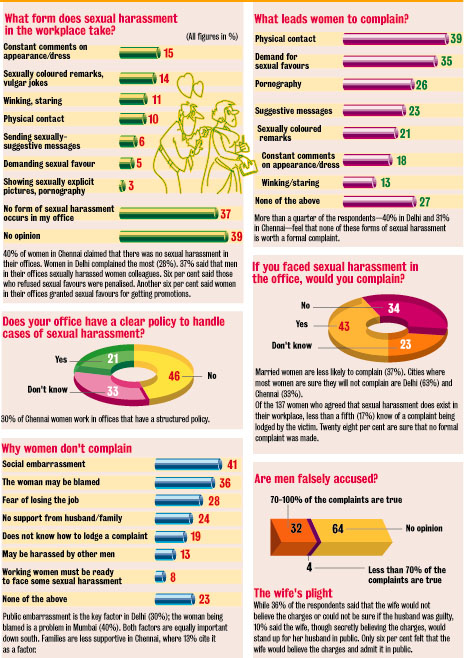
The Lakshman Rekha was not meant to be crossed. Ravana crossed it with disastrous results; things still turn gloomy when modern Ravanas cross this line in the workplace. The problem which came to light in the Vishaka vs State of Rajasthan case is still a major one-as seen in the TNS Mode survey commissioned by The Week. Of the 381 women-from Delhi, Mumbai, Chennai and Bangalore-polled between March 22 and 25, only a third stood firm on the claim that there was absolutely no form of sexual harassment in their office. However, more than 40% have said they would lodge a complaint if they were sexually harassed.
More than half the women polled worked in the public sector and 43%
of them were in the 21-30 age bracket, with most of them in the administrative/finance
departments. Seventy-five per cent were married which probably explains
why the majority were tight-lipped on how they would react if their husbands
were caught sexually harassing a woman in his office.
Though Delhi takes the cake as the 'capital' of sexual harassment,
the city women are far less likely to complain against it. A feeling mirrored
in Chennai.
Take a look at these figures to see how the average Indian working woman has to almost single-handedly fight the Ravanas at the workplace, in spite of the Supreme Court guidelines to protect them.
The Week Study: PANEL DISCUSSION
Foolproofing the law
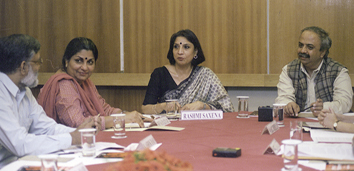
The Week conducted a discussion on the proposed
bill on sexual harassment in the workplace in New Delhi on March
16. The panel consisted of Mabel Rebello, Rajya Sabha member; Reva Nayyar,
member secretary of the National Commission for Women (NCW); K. Ashok Rao,
secretary-general of the National Confederation of Officers' Association;
Dr Arpita Anand, psychologist at Max Health; Kirti Singh, lawyer of the
All India Democratic Women's Association; and Mary Khemchand of the Young
Women's Christian Association. Rashmi Saksena, assistant editor of The
Week, moderated.
 Will
the bill help? (Left to right) K. Ashok Rao, secretary-general, Confederation
of Officers' Association; Reva NAyyar, member secretary, NCW; Rashmi Saksena,
Assistant Editor, The Week, and K.S. Sachidananda Murty, Resident Editor,
The Week, Delhi, at the panel discussion
Will
the bill help? (Left to right) K. Ashok Rao, secretary-general, Confederation
of Officers' Association; Reva NAyyar, member secretary, NCW; Rashmi Saksena,
Assistant Editor, The Week, and K.S. Sachidananda Murty, Resident Editor,
The Week, Delhi, at the panel discussion
Rashmi Saksena: We all know that the Supreme Court came out with guidelines on dealing with sexual harassment in 1997 in the Vishaka case. But apparently, an NCW study has shown that 60% of working women are still not aware of this.
Now a bill has been formulated. There are two aspects to the issue. One, is the bill actually required? If so, what does it aim to do? How is it going to help? Second, what are the existing lacunae? Why are we not able to get redress for the victims? There are many reasons for that. I am sure you will throw light on them.
 The
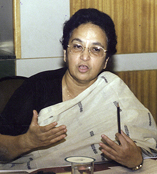
inquiry should be by an independent organisation like the NCW
The
inquiry should be by an independent organisation like the NCW
Mabel
Rebello, Rajya Sabha member
Mabel Rebello: As a member of the Committee on Women Empowerment, I have gone around the country and have interacted with PSUs, nationalised banks-be it Kochi Refinery, Chennai Refinery or Bank of Baroda. We have tried to find out whether the guidelines are implemented. Most of them say Yes. They always nominate a woman as the head of this committee. But they hardly get any complaints. Why is it so?
If anyone complains, who will conduct the inquiry? Some man or woman who is pro-management, pro-the harasser. The inquiry should be by an independent organisation like the NCW. If a woman complains and the boss is against her, her condition would be ten times worse than what she was in.
We need an enabling environment. Take PSU chairpersons, bank chairpersons, the media. Editors and all the decision-makers are men. Women are at the second or third rank. Except one Ranjana Kumar, who is the CMD of Indian Bank, how many women are there in effective decision-making positions?
What about the attitude of the women? Are we helping other women to climb up the hierarchy? We should push our womenfolk to help. The bill will help only in conjunction with an enabling environment.
 The
consequence has to be faced by the perpetrator
The
consequence has to be faced by the perpetrator
Dr Arpita
Anand, psychologist at Max Health
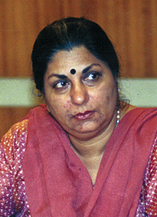
Reva Nayyar: This bill is a hard one to prepare. Consider the unorganised sector. Which man will sit in judgment and say, 'this landlord is bad, he is not paying wages, he is sexually harassing her'? How do we make her know that she has these rights? Very few women, even in the organised sector, are aware of the guidelines. It is a failure of the system. The employers ignore the Supreme Court directives; they do not take it seriously.
It has not permeated into their mindset that there should be a dignified and proper place and atmosphere where the dignity of women must be respected. You can work as a colleague. You can have fun. You can have jokes. But you cannot go beyond a point in leg-pulling just because you are in authority. Simply because you have a woman's career in your hand does not mean that you can manipulate her. It is very clear what sexual harassment is.
I don't know how much a legislation will add or detract from the effectiveness of action taken against sexual harassment. If the employer is benevolent and has good leadership qualities, this judgment is quite enough. But most of the employers play unprincipled games. When you look at that kind of unethical mindset, you also need a law.
The law should be easily understood by the police, so that they can file FIRs, and by complaints committees. Both the accused and the complainant should understand it. It should be simple but effective. The whole idea is to make the workplace safe, dignified and one where the girl feels that she is okay, she is getting equal treatment and will not be harassed.
 Simply
because you have a woman's career in your hand
Simply
because you have a woman's career in your hand
does not
mean that you can manipulate her
Reva Nayyar,
member secretary, NCW
Rashmi Saksena: The woman really reaches breaking point even before she complains. I think Arpita can tell us more; you must have probably come across cases like this. Are they on the increase?
Dr Arpita Anand: It is an extremely overwhelming experience. We are talking about how we can create a conducive environment which is safe enough to be able to make a complaint, and the constitution of the complaints committee.
There has to be some way in which women can be empowered not only to place the complaint but to go through the rest of the process as well. At present, there is no guarantee how the rest of the process will turn out. There might be a lot of negative feedback. As it is, the woman is in a vulnerable position. To top that, there will be a lot of pressure on her when she has made the complaint.
So maybe we can try and fine-tune the guidelines or laws so that we ensure that the consequences are not borne by the woman. The consequence has to be faced by the perpetrator. If men actually pay the price, one would hope that because of the fear of the consequence, people may begin to refrain from doing it. Therefore, before the final change comes about, some sort of fear of punishment must be there.
Mary Khemchand: My experience in the committee is extremely interesting because I have had differing feedback from different committees. There was one committee that consisted solely of managerial staff. I was the only NGO there. Six cases were referred to that committee. There are two sides to every story. It is only through experience that you learn. Out of the six cases, there were only two cases which had some validity. Then the question arose-what do we do next?
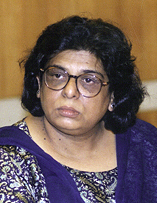
Kirti Singh: It is very important to look at the positive as well as the negative aspects of the guidelines. By making these guidelines, the Supreme Court has actually identified the need to have such laws. It is important to pinpoint the negative aspects of the judgment too. Everybody cannot go to the High Court or the Supreme Court under the provisions of the Constitution. So it is necessary to have a civil law on sexual harassment which provides that in every workplace, a committee may be set up which can inquire into the issue. In the absence of legislation, this cannot be done.
 If
the recommendations are not implemented the committee becomes ineffective
If
the recommendations are not implemented the committee becomes ineffective
Kirti
Singh, lawyer, All India Democratic Women's Association
The negative aspect of the judgment is, as Mabel Rebello and Mary pointed out, these committees are not representative. The judgment did not specify who should be represented in the committee. One of the very important aspects was employees' representatives should be nominated in the committee.
Another problem is that the recommendations of the committee are not mandatory. It is up to the management or the head of the institution to follow them. If the recommendations are not implemented the committee becomes ineffective. This is what is happening now.
Thirdly, no procedure has been outlined. What often happens is that a person found guilty by the committee goes to the High Court stating that the rules of natural justice have not been followed because of some lacuna in the procedure. There must be a proper procedure in which both the complainant and the accused are given a proper hearing. Besides, this is not applicable to the unorganised or informal sector. We have to think of some way in which to make it applicable there.
Also, women are being victimised. Once they make a complaint, if the committee has not found the perpetrator guilty, often they come up with more remarks against the woman who has complained. This kind of character assassination, this kind of harassment is worse.
The NCW-circulated bill redefines sexual harassment in the Indian Penal Code. It is defined in 509 of the IPC. It may be stalking, it may amount to sexual attack, touching. Sexual harassment includes a wide range of actions. We should keep to that definition for the civil damages. But the bill is very confusing.
It is important to distinguish between criminal and civil remedies in legislation. The definition talks of avoidable contact instead of following the Supreme Court definition. The bill talks of any act of verbal, sexually explicit or derogatory statement or remark, some of which may not actually affect the working of the person. In each case, you have to find out what kind of conduct it was. We do not want to make a Taliban state. We have to distinguish between being Talibanised by law and having a proper law in place. We don't want to be accused of being too touchy.
The point of the law is to deal with sexual harassment where it creates a hostile work environment, results in discrimination against women, makes it extremely uncomfortable for her to continue to work there, and affects her sense of well-being and safety.
 The
society is the starting point
The
society is the starting point
K. Ashok
Rao, secretary-general, National Confederation of Officers' Association
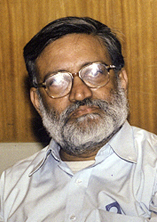
K. Ashok Rao: The workplace is a sub-system of a larger system. The society is reflected in the workplace. It is the starting point. The entire bill speaks of the post-event. Once a girl has reached the stage of complaining, it is already too late. The pre-complaint stage is important and we must reinforce a certain power equation. First of all, we must create a situation where a woman can make an informal complaint. Women talk about one-third reservation in Parliament. Is there one-third in trade unions? No. Unless women ensure one-third representation in the decision-making trade union, they will have such problems.
Now let us come to the complaint part. Departmental inquiry in a corruption case is different. Here are inter-personal relationships. Do I go for male bonding or do I go for my cause for the sake of the woman? How do I go to depose? What I am trying to say is you have to mobilise men and women. It is not enough that you treat it as if it is a woman's problem. You have to sensitise men; you have to make men aware.
Coming to the post-complaint part, I think the entire Bill has certain presumptions. First of all, it presumes that all sexual harassment is uni-directional. That there cannot be a kind of revenge when a mutually consensual affair breaks up. We have come across such cases. You must have the flexibility to have a door open for these kinds of things.
We must also publicise the punishment. If some guy has been found guilty, you punish him and put it in the newspapers. Paste it at the workplace. It has tremendous impact. It becomes a deterrent.
We need to understand the dynamics of sexual harassment in the Indian
context. We need to start with the fact that the workplace itself is not
homogeneous. We must divide the workplace as far as women are concerned
into officers, typists, stenos and so on. I think the workplace is quite
different for each of them.
| subscribe | query | chat | guest book | search-archive | home | to the editor | http://www.the-week.com/22apr14/cover.htm#1