|
Roof Top Rain Water Harvesting
Roof Top only refers to where the water is
collected from. Roof-tops are excellent rain-catchers. After the
initial run-off when the roof becomes clean and the water harvestable,
considerable amount of water can be caught from the roof tops.Actually the
Harvesting cycle involves
| Collection & Carrying - |
Filteration - |
Storage - |
Use |
|
We have two
of roofs -- one is RCC slab flat-roof and the other is traditional
sloping roof system. In case of a flat-roof, a PVC pipe or
Cement-pipe is appropriate and advisable. For sloping roof, the old
gutter system, which then bring water down in pipes to the next
stage |
Filters are required to remove the suspended
impurities. These impurities need to be filtered out in two stages:
first rain separation, and simple sieving.. |
The last
component which completes the Rainwater harvesting system is the
storage system. The water from filter is directed and stored in
tanks or sent to ponds or the shallow acquifers. |
Water stored in any of the systems is fit for use.
It can be used on a day to day basis for all needs. For drinking and
cooking, one will need to take standard care processes to clean and
decontaminate the water. |
There are three basic forms of RTRWH systems:
a. Individual tank based system where the water is stored into
brick/stone masonry tank or pre-cast ferro cement tanks or Polypropylene
tank (popularly known as Sintex tanks)
b. Surface Storage systems like ponds, tanks, etc.
c. Underground storage systems: mainly charging the existing aquifers
through directing the water into hand-pumps, Dug wells, Pits and / or
Trenches
The first two stages of the harvesting cycles namely the Collection and
the Filtration is common.
STAGE 1 -Collection & Carrying
All house roofs whether flat or sloping play the role of the harvester.
The quantity of water that can be harvested depends on the total area and
on the roofing material.
The most important thing to keep in mind is that the roof should be
cleaned of all leaves, dust or other material before the monsoons. The
roof should be strictly free of any dangerous materials like chemicals/
pesticides/ fertilizers.
House with Flat slab roof
A typical flat-slab house, constructed post-Tsunami is 350 sq.ft
built-up area. The roof of such a house would typically have one rainwater
outlet.
- Replace existing water-outlet with 4" diameter L-junction, either
PVC or Cement.
- The joint around is sealed with cement slurry.
- Check that the water does not stagnate in from of the water outlet.
If so redo the surface so as to ensure that water flows out well.
STAGE II - Filteration Rainwater is a pure form of water, free of any biological & bacterial
contamination. However, when it rains some suspended impurities in the
atmosphere get dissolved in the rain. The roof and gutters have
accumulated organic and inorganic matter in the form of leaves, dust,
sand, mud etc. As the rain hits the roof all these impurities dissolve
into the rainwater or are carried along. These impurities can affect the
quality of the water collected. To prevent any form of contamination of
the water being harvested, these impurities need to be filtered out.
This filtering is carried out in two stages:
1 First-Rain separator:The first rain-separator is a built-in plumbing
system that separates the first few minutes of the rain. 2. Filter: After the first rain separator, the rain water will
still carry suspended impurities. These need to be filtered out. This can
be done with a simple sand – stone – charcoal filter. Even
a clean folded cotton cloth placed in a sieve acts as an effective filter.
First Rain Separator
Most of the dust and organic matter deposited on the roof dissolves and
flows within the first few minutes of the rain. This water needs to be
separated in order to prevent contamination of water being harvested.
The first rain-separator is a built-in plumbing-system that separates the
first few minutes of the rain without any major need of supervision.
A 4" diameter PVC junction pipe is fixed into the lower end of the
L-junction that comes from the roof.
A 4" down-pipe is fixed to the lower end of the T-junction. It usually
will go upto 30 cm (1 foot) above the ground level. The down-pipe is then
provided with an L-junction. This L-Junction has an end cap. This
contraption from T-junction below works as the first-rain-separator.
Downpipe: To the lower outlet of the T-Junction we have fixed the first
rain separator described above. Fix a 4" L-junction to the other upper
outlet. Fix a 4" downpipe to the L-junction that goes to the filter
described below.
How it works:
As the rainwater from roof flows down it first fills up the down pipe
(described above as the first rain separator). The quantity of water
stored in the downpipe equals the first few minutes of rain and will carry
with it most impurities. As the downpipe fills up the water starts flowing
out of the T-junction (from its upper outlet) into the other downtake pipe
which takes the water to the filter.
After every rain, it is advised that the end-cap from the bottom is
released and water collected in this empty portion of pipe is flushed out.
So that it is ready to store the first few minutes of the rain for next
time.
Filter
The water that comes for filtration after the filling up of the first rain
separator would still have suspended and dissolved impurities. These need
to be filtered out. These filters can be of different types.
We can rely on a simple stone-sand-charcoal filter. It is easy to
construct and maintain.
- Take any 20 litre container or plastic drum or a plastic bucket.
- Make an opening in the drum cover so that a 4" diameter PVC pipe can
enter.
- On one side of this drum/ bucket (or on the bottom side) make an
opening so that a 4" pipe can be fixed as an outlet. This joint should
be sealed from the inside.
- Fill the container with a layer of baby jelly, and then a layer of
coarse sand and on the top a layer of charcoal. Ensure that at least 6"
at the top is left open. Slow percolation of water through the layers
i.e. the filtration medium ensures that the dissolved and suspended
impurities are filtered.
STAGE THREE:
A: TANK BASED RTRWH SYSTEMS
B. SURFACE WATER RECHARGE RTRWH SYSTEMS
C: WELL & BORE RTRWH SYSTEMS
Usually when talking about Roof top Rain water
Harvesting, people are referring to the system where the storage is in a
tank.
However, water collected from roof tops are also
use for re-charging shallow acquifers through recharge pits and trenches,
which help to regenerate local ponds and other water bodies. They
can also be designed to channel water to specific openwells and
bore-wells.
| TRAPPING |
The Lifelines of Tamil Nadu
Kanmois are traditional tanks with earthen bunds
constructed many centuries ago. They are large surface water stores
that collected and stored surface water run-offs. They largely
supported and were used for agricultural purposes as well as for
drinking water.
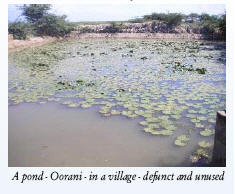
Ooranis are small ponds that have collected rainwater
from rains and from surrounding catchment areas. These Ooranis
traditionally were used for various needs of drinking, washing, bathing
needs of the villages around it.
Oorani is a Tamil word meaning village
pond. It is an institution as old as Tamil society. Poet Thiruvalluvar
referred to them 2000 years ago. Ooranis were usually endowed by ruling
or merchant princes. Beneficiaries were involved in excavation and
maintenance. They developed a sense of ownership. After Independence
the government departments took over every aspect of village management
and Ooranis fell to neglect.
read more on
this : Dhan
foundation site
MSSRF site
 |
The concept is so interesting that it has
inspired the government to launch a scheme called "nammaku namme
thittam" (meaning we are our own support) which is based on the
Kudimaramathu practice of the ancient times.
|
|
. 
|
 |
The following table gives us an idea of how
much water can be harvested from different sizes of structures and the
best method for harvesting rainwater.
Estimation of Potential Runoff available from Roof Top
|
AVERAGE ANNUAL RAINFALL =
732.13 mm |
|
ROOF AREA (m2)
|
TOTAL RAINFALL VOLUME
|
VOLUME AVAILABLE FROM
RAINFALL (90%) (cum) |
TYPE OF STRUCTURE RECOMMENDED FOR RECHARGE
|
|
|
|
Alluvial area |
Hard Rock area |
|
50 |
37.61 |
32.95 |
Recharge pit/ hand pump |
Recharge pit/ hand pump |
|
100 |
73.21 |
65.89 |
Recharge pit/ hand pump |
Recharge pit/ hand pump |
|
150 |
109.82 |
94.84 |
Recharge pit/ hand pump |
Trench/hand pump |
|
200 |
146.43 |
131.78 |
Trench |
Trench |
|
250 |
183.03 |
164.73 |
Trench |
Trench |
|
300 |
219.64 |
197.68 |
Gravity head recharge well |
Gravity head recharge well |
|
350 |
256.25 |
230.62 |
Gravity head recharge well |
Gravity head recharge well |
|
400 |
292.85 |
263.57 |
Gravity head recharge well |
Gravity head recharge well |
|
450 |
329.46 |
296.51 |
Gravity head recharge well |
Gravity head recharge well |
|
500 |
366.07 |
329.46 |
Gravity head recharge well |
Gravity head recharge well |
|
1000 |
732.13 |
658.92 |
Gravity head recharge well |
Recharging shaft/dug well |
|
2000 |
1464.26 |
1317.83 |
Recharging shaft/dug well |
Recharging shaft/dug well |
|
2500 |
1830.33 |
1647.29 |
Recharging shaft/dug well |
Recharging shaft/dug well |
|
3000 |
2196.39 |
1976.75 |
Recharging shaft/dug well |
Recharging shaft/dug well |
|
4000 |
2928.52 |
2635.67 |
Recharging shaft/dug well |
Recharging shaft/dug well |
|
5000 |
3660.65 |
3294.59 |
Recharging shaft/dug well |
Recharging shaft/dug well |
 |
" I dont mind staying in the tank "
|
|

