 |
Stormwater run-off? The
monsoon brings with it very welcome showers. The earth sings with joy
after a hot summer. People feel a great relief from heat and from the
suffering of lack of water. We all welcome rain with open arms. The
monsoon brings with it very welcome showers. The earth sings with joy
after a hot summer. People feel a great relief from heat and from the
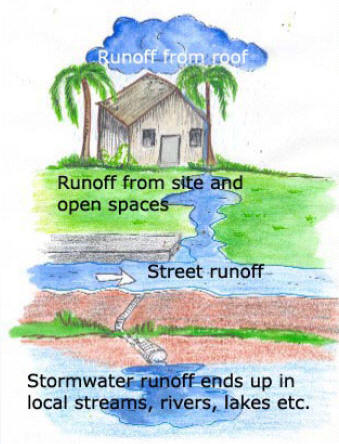
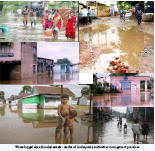
suffering of lack of water. We all welcome rain with open arms.Yet, many a times, the rain which we wait for so longingly becomes a curse, a problem. There are floods. some manageable and some unmanageable .resulting in destruction, health hazards, epidemics and what not. If nothing else, it results in water-logged areas near the habitation creating major incon-veniences in access and mobility and become breeding houses for mosquitoes, flies and every other germ and bacteria. Thus the gift can turn into a curse. Rainwater, has a cycle. The way the water moves through the landscape decides very much how the land and people live. Does the water move fast and cause erosion ? Does the water meander and thus is beneficial ? What does it carry with it and what does it bring with it ? As one can see in the picture, runoffs from roofs move into open spaces and streets around the house sites. From there, following the slope of the land, they collect and drain into the nearest water bodies. Managing this water run-off can be very beneficial. It would mean increasing the time the water takes to reach the water bodies, the speed with which the water moves towards them, what it carries with it etc.
Storm water runoff is the volume of water generated by a storm that
does not infiltrate into the ground or is not retained in storage as
surface water. As the name suggests, it runs off. Runoff flows overland
during and following a rainfall, picking up material along the way as it
moves downgrade to a river, stream, lake or reservoir. The volume of storm
water runoff is related to the amount of impervious surface areas
in a watershed. Impervious areas are those areas which do not allow water
to seep into the ground. Urbanization and the resulting increase in land
area devoted to parking lots, rooftops, and additional roads is the
primary source of increases in storm water runoff.
Storm water runoff occurs over a very
small percentage of the total land area, yet it is responsible for a
majority of the surface water pollution. As urbanization occurs, the speed
with which a drop of water in a remote area of the watershed can make its
way to the receiving surface water (i.e., streams or lakes) is increased
considerably. Not only is it quicker for water to flow over paved surfaces
versus natural soil, but storm sewers further expedite drainage into the
nearest lake or river. A drop of water that used to take hours or days to
make its way through a watershed to a channel is now there in a matter of
minutes or hours. Effects of increased storm-water runoff The increase in storm water runoff has its consequences. The increased speed with which the storm water runoff enters the receiving rivers and streams means that channels flood more frequently in response to relatively small storm events. This concept is easily illustrated by a stream hydrograph, a measure of the amount or volume of water passing by a point on a stream over time. As seen on the conceptual hydrographs presented in Figure 1, increased runoff causes the volume of water to increase rapidly, pushing the peak discharge of the stream much higher for the same storm event. The higher the discharge the more power the stream has for erosion, and thus the channel becomes unstable and begins to incise or widen to accommodate the new peak discharge. Unstable channels jeopardize the stability of bridges and other structures located along stream channels.
The same storm event results in two different runoff regimes. Increased
development increases the area cove
Storm water itself is a concern when present in large quantities. Storm water can be detrimental to the environment due to the sheer volume of water that falls into an area.
Stormwater also carries with it many pollutants which eventually reach the different water bodies and also permeate into the ground. Good stormwater management practices can eliminate or reduce such pollutants.
Table 2: Common Pollutants in Storm Water
source
Storm water runoff picks up a variety of pollutants that degrade the
quality of surface
waters. Sediment is by far the most visible and common pollutant
carried by storm
water runoff into rivers and streams.
Sediment has drastic effects on aquatic life living in the stream and
also causes increased
dredging and decreased reservoir capacity over the long term.
The impacts to our waterways from unchecked storm water runoff are
substantial.
The consequences are not only biological, but economic as well as
aesthetic.
Populations of fish and other aquatic organisms decrease, the capacity
of the
waterbodies to store water decreases, waterbodies get polluted etc.
|
 |
 What
is Storm Water Runoff?
What
is Storm Water Runoff?
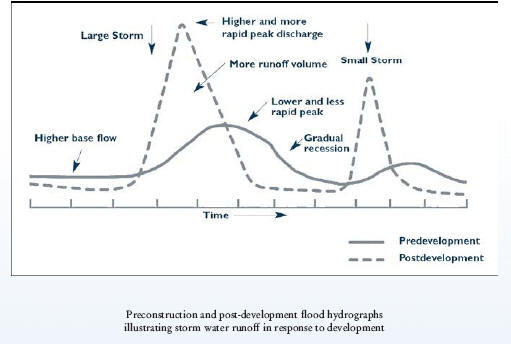
 red by impermeable surfaces, so the
volume of storm water runoff increases and also reaches its peak volume
sooner after the initiation of the runoff event.
red by impermeable surfaces, so the
volume of storm water runoff increases and also reaches its peak volume
sooner after the initiation of the runoff event.