|
The Larger
Picture in Tamil Nadu
 |
Let's take a quick look at Tamil Nadu
and especially the tsunami affected regions of Tamil Nadu.
Remember that the more appropriate
Construction and Resource Management techniques are region-specific.
Thus it is worthwhile first learning about the region we will apply our
management techniques in.
|
Ground
water quality
Tamil
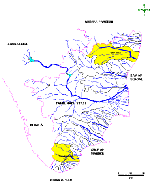
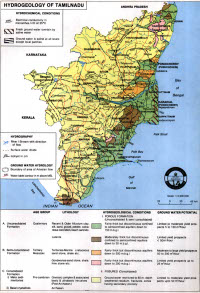
Nadu has its share of problems with groundwater quality. The main
problems it faces are of salinity (inland salinity as well as coastal
salinity) and Fluoride content in its ground water resources. The
districts most affected by salinity are Karaikal and Pondicherry,
Nagapattinam, Pudukottai, Ramanathpuram, North Arcot, Dharamapuri,
Salem, Trichy and Coimbatore. The fluoride content is high in the areas
of Dharampuri, Salem, North Arcot, Villipuram, and Muthuramalingam.
click here for larger
image
Tamil Nadu
is a coastal state prone to droughts. The climate of this state ranges
from dry sub-humid to semi-arid. (Sub-humid regions are those regions
where moisture is normally less than under humid conditions but still
sufficient for the production of many agricultural crops without
irrigation or dryland farming. Semi-arid regions are regions
that are between the
desert climates and humid climates in ecological
characteristics and agricultural potential).
|
Water Resources:
Though
Tamil Nadu is largely a dry region it has several perennial rivers -
Palar, Cheyyar River, Ponnaiyar, Kaveri, Meyar, Bhavani, Amaravati,
Vaigai, Chittar River & Tamaraparani and a few non-perennial
ones too - the Vellar, Noyal, Suruli, Gundar, Vaipar, Valparai and
Varshali. Canals,
tanks and wells are the main sources of irrigation for farmers in the
state. As of 2005-2006, the state had 2395 canals with a length of
9,747 km, 40,319 tanks, 670 ordinary government wells, 1,620,705
ordinary private wells and 290,611 tube wells.
Rainfall in Tamil Nadu
Tamil
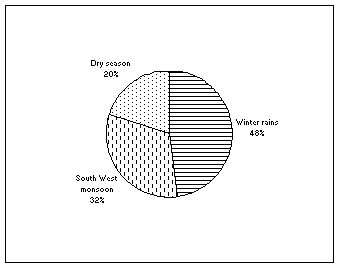
Nadu has 3 distinct periods of rainfall. It receives a little rainfall
during the monsoon season (from June to September). It receives its
maximum rainfall during the North-East monsoon or what is popularly
known as winter rains (from October to December). It also receives a
little rainfall during the dry season (from January to May).
Under normal conditions the state receives about 945 mm
(37.2 in) of rain. Since the state is entirely dependent on
rains for recharging its water resources, monsoon failures lead to
acute water scarcity and severe drought.
Each
year, Tamil Nadu receives quite a substantial amount of rainfall. This
precious rainwater rushes out through drains, nallas and flows
out into rivers and to the sea. Billions of litres of fresh water are
lost each season.
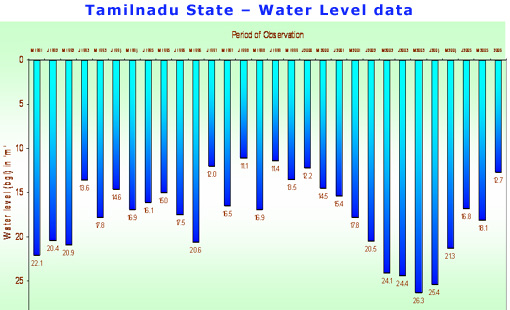
Groundwater
is depleting rapidly. Our rivers are drying. Our wells are drying.Our
lakes are dying. We are boring deeper and deeper into the ground in
search of the elusive drop and are extracting much more water from
the round than nature is able to fill up, until it has now
become a major problem.
Women
walk kilometers to fetch water. Inadequacy of water has affected every
aspect of life.
|
|

Source: www.tn.gov.in |
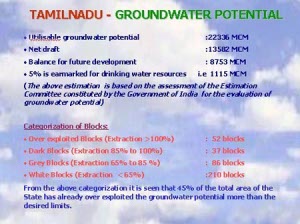
In
Tamilnadu, as many as 52 blocks have been classified as overexploited
blocks where the ground water extraction has exceeded the recharge
level, 37 blocks have been classified as dark area blocks where the
ground water extraction is more than 85 % of the estimated recharge and
86 blocks have been classified as grey areas where the exploitation is
between 65% to 85%.
|
Drinking water:
Under
the Rural Water Supply Programme, the norms are to provide 40 litres of
water per day per person, in the rural areas. These norms are arrived
at with the following break ups: 3 litres for drinking, 5 litres for
cooking, 15 litres for bathing and 17 litres for other purposes.
It also states
that .wherever sources permit, a norm of 55 lpcd is adopted with
provision for individual house service connections in such habitations
Status
of Rural Water Supply
The policy notes state that periodical surveys are conducted in the
rural areas to assess the status of water supply. Based on the levels
of supply, rural habitations are classified into four categories as
.not-covered., i.e. habitations with no supply;.no safe source., i.e.
habitations affected with quality problems; .partially covered., i.e.
habitations with supply below 40 lpcd; and .fully covered.,
i.e. habitations provided with 40 lpcd.
|
The status of rural habitations as on
01.04.2001 is as follows :
| Status |
No. ofHabitations |
| Not
covered |
Nil |
| No
safe source |
931 |
| Partially
covered |
4,085 |
| Fully covered |
61,615 |
|
Total |
66,631 |
http://www.tn.gov.in/policynotes/archives/policy2001-2
/twad-e-2001-02.htm |
|
|
|
|

|