http://www.sanctuaryasia.com/news/detailnews.php?id=707
News
11th February 2003
People say NO to interlinking rivers in India
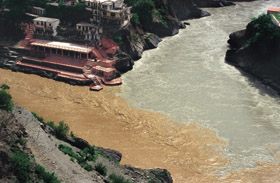
A Civil Society Dialogue on India's proposed Interlinking of Rivers, organised by WWF
Switzerland in association the Delhi-based Development Alternatives concluded that India
did not need river linking. The participants agreed that India instead needed
people-centred local water solutions that could address the peoples' real needs.
An eight-member Special Task Force has been set up to monitor interlinking of major
rivers within 15 years to tackle droughts, floods and disputes at an estimated cost of Rs
5,60, 000 crores. The 100-odd participants at the Dialogue unanimously stated that there
was a lack of transparency. Even basic information such as the various pre-feasibility and
feasibility studies conducted by the National Water Development Agency for the last 20
years or the Report of National Commission on Water had not been made available to the
public. In such a scenario, the proposal to set-up an independent Peoples' Commission to
assist the government was not only deemed ridiculous but a step towards self-cooption.
"When the Ganga is water deficit according to the controversial Indo-Bangladesh
Water Treaty, how can it be shown as water surplus in the new plan", questioned
Ramaswamy Iyer, former Water Resources Secretary. Himnashu Thakkar of South Asia Network
on Dams, Rivers and People (SANDRP) asked, "Without the availability of basic
information, transparency and accountability of the water resources establishment, how can
there be a dialogue? No area of the country needs such schemes for drinking water
needs". V.B. Easwaran of National Wastelands Development Board made it clear that
hundreds of examples from across the country had shown that local systems and watershed
development would be much better, cheaper and faster in drought mitigation. Basant, a
farmer from Bihar expressed horror at the attempts of the new "Bhagiraths" such
as Prabhu to ferry water across the nation.
Justice B. N. Kripal, who had given the order for linking of rivers across the country,
reportedly stated just few days after his retirement that his views on the interlinking of
rivers was merely a suggestion and not an order.
"The political consensus on the issue of interlinking of rivers is a myth. Already
states like Assam, Bihar, Kerela, Punjab, Orissa, Goa, West Bengal and Maharashtra have
raised objections to it," said Dr. Sudhirendra Sharma, director of The Ecological
Foundation. He warned that the plan would lead the country into further debt, when the
current outstanding debt is already US$ 100 billion.
The proposal of the government to start a dialogue and set up a People's Commission
after taking a decision was meaningless and the forum opined that people must be empowered
at an early stage to show the non-viability of such destructive schemes and the
sustainability of alternatives.
While the government had claimed that it would conduct a detailed project report on
river links such as Par-Tapi-Narmada, Toxics Link, stated that it did not answer the
question of whether people living on the banks of Tapi and Narmada were willing to link
their river with the mercury contaminated waters of Par.
The Dialogue pointed out that the Special Task Force on Interlinking is in contravention of the spirit of National Water Policy which states that: "There is an urgent need of paradigm shift in the emphasis on the management of water resources sector. From the present emphasis on the creation and expansion of water resources infrastructure for diverse use, there is now a need to give greater emphasis on the improvement of the performance of the existing water resources facilities".
About us | Advertise | Syndication | Fine print | Contact us | Sitemap |