MEDIA
|
The importance
of the media, as we know, stems from its power to reproduce, interpret
and disseminate information. This power is predicated on the social recognition
that citizens have the right to information. In other words, the media
is the vital link in the democratic process through which people
acquire information,
form opinions and respond as members of a nation, a society, a community.
The capacity of the media to bring a change in the situation where
riots have broken out for better or for worse lies, in the public
response it stirs. |
The coverage of Gujarat had two aspects - one was the coverage by the electronic
media and another was the coverage by the print media. Both have come for
sharp criticism from those who hold different viewpoints in the communal,
religious, political, social and ideological spectrum of our society. There
is sharp criticism that the flood of media coverage unleashed more virulent
forces onto the streets, even as it failed to galvanise an immbolised and
petrified administration. There is also the serious charge that the media
encouraged the frenzy of communal violence by carrying provocative statements,
slogans and visuals. On the other side, media men faced the fury of the
mobs on one hand, and the intimidatory tactics of the establishment. These
riots were the first to be televised so widely after the growth of 24 hour
cable news channels. The Gujarat Government and the BJP government at the
centre were quick to attack the media for its coverage. They felt that
the media overplayed the issues, whereas others felt that it was because
of this coverage that there was pressure on the state to act.
Reporting a riot is as sensitive and challenging as the event itself.
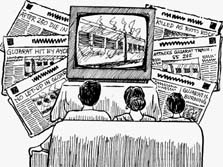
The impact of TV reporting with visuals is bound to have more impact than
what is carried in the newspapers. Basically, both print and electronic
media are called upon to ensure that information disseminated is factually
correct and does not vitiate the atmosphere further. In fact the Press
Council of India has suggested the same guidelines for the media. It is
not the first time that the media has been urged to maintain self-regulation.
But the changing patterns in the media are also attributable to the
fast disappearing authority of the editor in
a news organisation.
Journalists covering communal riots in the country over past decades
have noticed a sea change in conditions of work and the risks they run
over the past decade and a half. Prior to 1992, when communal violence
did not involve the mobilisation of large mobs/cadres, a reporter doing
his/her duty could move around with the expectation of reasonable impunity.
When the television camera focuses on a riotous mob or its victims,
it leaves little to the imagination of the viewers. If, under such circumstances,
newspapers have disregarded the old guideline, they can hardly be blamed.
Now the question is, whether the freedom the Press has exercised in this
regard has set a healthy precedent or not.
In the latest episode of Gujarat violence, the Muslims were the first
to strike at Godhra. The media could not escape the compulsion of condemning
the attack. Yet, they could not resist the temptation of blaming
the Vishwa Hindu Parishad for providing provocation to the arsonist mob.
Every newspaper blamed the VHP.
The English media lived up to its responsibility in exposing the extent
of the tragedy. In fact the print media has taken over from
where the electronic left. The socio-political factors, the exploitation
of vote banks, the polarisation through communalism-print media is focussing
precisely on this without hurting sentiments or inflaming passions.
Incidents like communal riots give rise to debates, whether the media
has covered them right or wrong. And the recent tension in Gujarat has
put the media under vigilance. It is not the job of the government to decide
what the media should or should not do. It is media's responsibility to
chalk out the code of coverage of communal violence so that it does not
incite more violence. It is a code where newspapers do not give authority
to wild statements or guesswork on the origin, nature and toll of a riot
and where news channels should agree to delayed telecast of live coverage
of riots. This would give editors of news channels time to evaluate just
how provocative the scenes and statements from the street are. These are
self-imposed restrictions, where the right of the reader or viewer is not
hindered and the coverage does not encourage
more communal violence.
(Footnotes: http://www.thehoot.org/mediawatch/selective.asp
,http://www.reportingpeople.org/issues_medstory6.htm
,
http://www.sabrang.com/cc/current/attonmedia.htm
.)
Reporting Gujarat: how objective
was media coverage?
No balanced approach by vernacular
dailies |
|
| Gobind Thukral
How did the local Press presented the riots to the readers?
Has the print media in any way aggravated the relentless tensions through
inflammatory or communal reportage? These questions bother all right thinking
people.
Sandesh
crossed all limits of responsible journalism. Its major characteristic
was to feed on the prevalent anti-Muslim prejudices of its Hindu readership
and provoke it further by sensationalising and distorting news. Sandesh
used headlines to provoke, communalise and terrorise people. ...
CED Ref: Gujarat/media/gujarat_media2.htm
|
|
|
THE ROLE OF NEWSPAPERS DURING THE GUJARAT
CARNAGE: |
|
a brief analysis for the period Feb 28 to March 24, 2002
By PUCL Vadodara and Shanti Abhiyan, Baroda
Gujarat has been ravaged by unprecedented violence since 27th February
sending shockwaves all over the country. The spell of genocide that followed
the Godhra massacre have seen newspapers playing a significant role in
the long spiral of violence. Shanti Abhiyan and PUCL (People?s Union For
Civil Liberties), two Baroda-based organisations have been following the
vernacular press as well as the English newspapers to analyse news reportage
throughout this period.
The purpose of our analysis was to find out how the local press presented
the riots to the readers. We wished to examine if the print media has in
any way aggravated the relentless tensions in the city through inflammatory
or communal reportage. For this it was important to look at individual
newspapers and to also compare across newspapers. We have covered Gujarati
language newspapers like Sandesh (Baroda Edition), Gujarat Samachar
(Baroda Edition) and Gujarat Today. The Times of India and Indian Express
are the two English dailies that we have analysed here.
A framework of analysis was drawn up to ensure a standard evaluation
of all the newspapers we were scrutinising. The framework attempts to locate
all the factors that would influence the quality and content of reportage.
This in turn determines readership response to incidents being reported
nationally and locally. Additionally, it also helps to contain or conflagrate
communal tension and hostility.
CED Ref: Gujarat/media/gujarat-media.htm
|
| Fiddling With Facts As Gujarat Burns |
|
BALBIR K. PUNJ
The report, carried just two days after Godhra, mentions the murder
of Ram sevaks only once in the 450-word plus report. What is important
is that Varadarajan, sitting in Delhi, makes readers 'doubtless'
about the planning in the backlash while defending Godhra, the indefensible...
CED Ref: Gujarat/media/Gujarat-burns.htm
|
|
| RIGHTS AND WRONGS: Ordeal by Fire in the
Killing Fields of Gujarat Editors Guild Fact Finding Mission Report |
| by AAKAR PATEL, DILEEP PADGAONKAR, B.G.VERGHESE
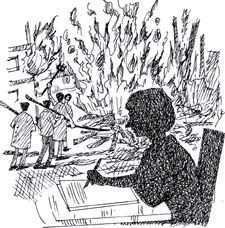
As Gujarat erupted on February 27, there were those who blamed the print
and electronic media for aggravating tensions and inflaming passions by
their graphic or sensational coverage. While some thought it fit to shoot
the messenger, there were voices from the media alleging impediments, threats
and attacks to thwart their independent and objective functioning. Responding
to these very divergent points of view, the Editors Guild of India Executive,
with its President, Mr Mammen Mathew, Editor of the Malayala Manorama,
in the chair, decided to depute a fact-finding mission to Gujarat to report
on the situation.
Competition for ratings and circulation can sometimes be negative media
drivers with trivia, with titillation and sensation crowding out more studied
reportage and analysis. The need for political and economic reform in India
has been amply debated, even if action on the ground has been disappointing;
but can the same be said of social reform and analysis of deeper societal
changes?
CED Ref: Gujarat/media/mediareport.htm
|
Source:
http://www.thehoot.org/mediaresearch/gujaratevents.asp