Settlement Planning
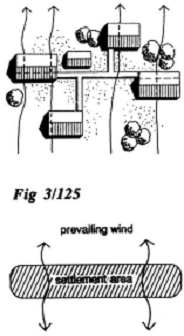
In a coastal location in Tamil Nadu, with high humidity and radiation levels a meandering layout encourages good natural ventilation as a result of the land-sea breeze. Heavy thatched roofs of the traditional houses, provide good insulation from radiation and the net heat gain is also less. Staggered houses serve as wind breaks and check the wind tunnel effect, perfecting thermal comfort at negligible energy expense.
The traditional settlement pattern, clustered, linear or grid pattern, typically have main roads that run parallel to the coastline and by-lanes that run perpendicular to the coast, and terminate at the main roads. As these lanes join the main road, they usually have a meandering layout and converge or at least lead to a community building - typically a temple, that would normally have a solid structure, deep foundations, thick walls and high roofs with several openings. Houses are arranged, along these lanes, in a slightly staggered fashion both with regard to their location on ground as well as location of the main opening. As a result, the main entry of one house would normally, overlook the open space of the house opposite. While this type of a layout has a strong social logic in terms of privacy when locating main entrances, or religious as in the case of the lanes terminating at the temple, there is strong logic also in terms of promoting thermal comfosrt with respect to movement of air.
Settlment Pattern
An open settlement pattern, which provides and enables good air circulation, is the appropriate response to the Tamil Nadu climate. Buildings should be scattered and have a low population density. Buildings should be separated with large, free spaces between them. Groups of buildings should not be built in too compact a manner. This allows airflow which provides ventilation for cooling and a hygienic environment.
In cases where settlements consist of several rows of buildings, the houses should be staggered to avoid wind shaded buildings in the downwind rows.
Extended settlements, arranged in a line across the prevailing wind direction give low resistance to air movement and are, therefore, also is an ideal solution.
Public spaces should be arranged in a manner that the walking distance to them is minimal. External public spaces, streets, squares and footpaths should be protected from sun and rain.
The settlement pattern should allow for a loose open street network. Street spaces should be long and straight to facilitate air movement and lined by high, shade-providing trees.
Squares and passages should be covered, but cross-ventilation should not be impeded. Generous and well distributed areas of vegetation help to improve the microclimate.
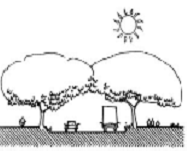
Certain species of trees (e.g. rain trees) form an extraordinary outdoor space by creating a canopy effect. They should not be planted too far from each other, so that the crowns form a wide hall like space, creating a comfortable microclimate.
Landscaping with vegetation
Many of the reconstruction areas are devoid of trees. Considering that the temperatures in Tamil Nadu can be very high in summer, trees and plantations become an imperative.
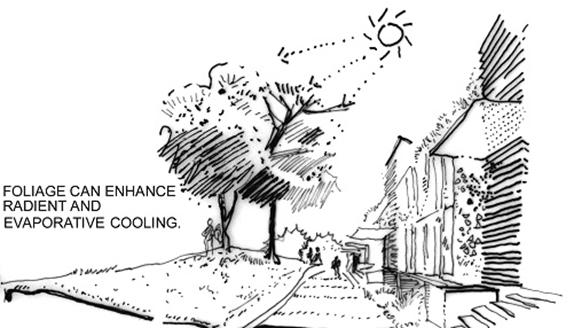
An unshaded pavement exposed to the sun heats up and can reach very high temperatures. A vegetal cover of the ground, however, keeps it comparatively cool and contributes much to a cooler outdoor microclimate.
Unshaded pavements should be avoided as far as possible and where not possible, air should not be allowed to pass over such hot surfaces before reaching buildings.
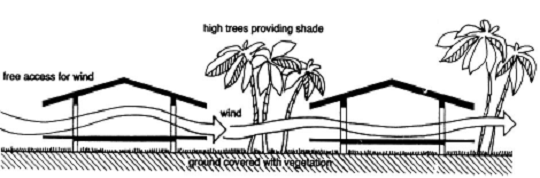
High trees with wide, shading crowns provide significant protection from solar radiation and should be incorporated as much as possible into any landscape planning.
High and dense bushes, however, should be avoided near buildings because the space between the ground vegetation and the high crowns of the trees should remain open, providing free access for the wind at the level of the living spaces.
Many of the areas in coastal Tamil Nadu are cyclone prone. In such areas a good and varied height cover will act as wind-breakers protect the settlement and houses.
In dense settlements it is difficult to provide privacy as well as allowing the free flow of air. Various systems of paling fences and screen walls have been devised consisting of louvered or overlapping timber boards or planks. They do not permit a direct view and allow breezes to penetrate, but reduce the air velocity quite substantially. A suitably spaced, scattered settlement pattern helps to avoid fences, yet provides privacy.
Shade all external openings and walls including those facing south.
Use covered outdoor living areas such as verandahs and deep balconies to shade and cool incoming air.
Use shaded skylights to compensate for any resultant loss of natural daylight.
Choose and position landscape to provide adequate shade without blocking access to cooling breezes.
Use planting instead
of paving, to reduce ground temperature and the amount of reflected heat.
A 'fly roof' can be used to shade the entire building. It protects the
core building from radiant heat and allows cooling breezes to flow beneath it.
Building design
Since the resettlement areas are hot and humid areas, attention has to be paid to minimizing heat and the effects of the sun, and make maximum use of air flow and winds to dissipate the heat. This reduces the need and usage of fans which will go towards reducing operational energy costs.
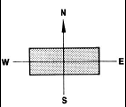
· The main elevations and rooms should be placed facing north and south and towards the prevailing wind.
· The form should be spread out.
· Provide generous shade for direct and diffused radiation.
· Provide effective cross ventilation.
Orientation of buildings
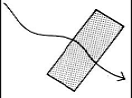
Shading of the east and west elevations is difficult because of the low sun, and may require special devices; whereas the south and north sides can easily be protected by an overhanging roof. Thus the best orientation for protection from the sun is along the east-west axis.
· Where a predominant wind direction can clearly be identified, long shaped buildings should be arranged across this direction.
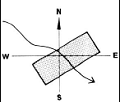
Often the above two parameters are contradictory. In this case, a reasonable compromise should be made based on a detailed analysis of the specific situation, considering the possibilities for diverting the wind direction by means of vegetation and structural arrangements, such as parapet walls within the external adjoining space.
Shape and volume
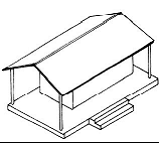
Forms with large surface areas are preferred to compact buildings. This favours ventilation and heat emission at nighttime.
Type and form of
buildings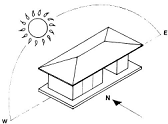
The main goal is the reduction of direct heat gain by radiation through openings and of the internal surface temperature. The building should therefore be designed not only with protected openings, but also with protected walls. This task will be much easier if the building is kept low. In addition, the roof should extend far beyond the line of walls, with broad overhanging eaves and other means of shading.
· The intense diffuse solar radiation calls for buildings that have large overhanging roofs and wide shaded verandahs.
· Row houses elongated along the east-west axis provide the best shading of the critical east and west walls.
· These critical east and west walls are best protected if the house is covered with a hipped roof.
Room arrangement
The high humidity and warm temperatures in the area require maximum ventilation, which leads to very open buildings.
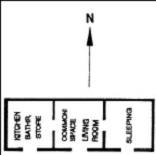
The arrangement of rooms depends on their function. Since the thermal load is related to the orientation, rooms on the east side are warm in the morning and, if not built with much thermal mass, cool down in the afternoon. Rooms on the west side are cooler in the morning and heat up in the afternoon. Rooms facing north and south remain relatively cool if provided with adequate shading. Thus, the rooms can be arranged according to their functions and according to the time of the day they are in use.
Bedrooms can be adequately located on the east side, where it is coolest in the evening. Good cross-ventilation is especially important for these rooms because, at rest, the human body is more sensitive to climate. On the other hand, stores and other auxiliary spaces can be located on the west side.
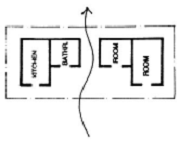
The main rooms which are in use most times of the day, such as living rooms, should not be located on the east or west side.
Rooms where internal heat occurs, such as kitchens, should be detached from the main building, although they can be connected by a common roof. Provided the kitchen is mainly used during morning and midday hours, it can be located on the west side as well.
Special attention should be given to the arrangement of rooms with a high humidity (bathrooms). Proper cross-ventilation is especially important to avoid mould growth.
Immediate external space
The same principles of maximum shading and maximum ventilation also apply to the design of the outdoor space. Tall shading trees and scarce ground vegetation are important
Insulation
Insulation acts as a barrier to heat flow and helps to keep the house warm in winter and cool in summer.
Bulk insulation mainly resists the transfer of heat. It depends on pockets of trapped air within its structure. Its thermal resistance is essentially the same regardless of the direction of heat flow through it.
Filler slabs provide excellent bulk insulation.
Reflective insulation mainly resists heat due to radiation. It resists heat due to its high reflectivity and low emissivity (ability to re-radiate heat). It relies on the presence of an air layer of at least 25mm next to the shiny surface. The thermal resistance of reflective insulation varies with the direction of heat flow through it.
Verandah roofs should be insulated since outdoor living spaces are used extensively, to reduce radiant heat gain. Heat build up under verandahs not only affects the space below but can affect conditions inside the house.
External walls should be insulated to reduce radiant, conducted and convected heat transfer. Cavities in walls provide excellent insulation. Rat-trap bond walls thus can provide very good insulation.
Insulation of Exposed Walls
Heat and cold radiate through
exposed walls of the house.
1. Suitable thickness of wall may be provided.
2. Hollow wall or cavity wall may be provided.
3. Hard boards or ply board may be fixed on wooden batten over the wall for creating air space.
4. Thermal insulating material sheet as thermocol etc. may be fixed inside and outside exposed wall for reducing heat/cold transmission.
5. The outer wall may be constructed with thermal insulating material in case of frame structural building or non load bearing walls.
External Insulation of Roofs :
1. Suitable shade may be provided on exposed top surface of the roof for reducing solar radiation.
2.
Shining and heat reflecting coating may be applied on the top of exposed
roof like paint.
These coatings can serve dual purpose of water proofing and heat reflection.
3. In case of flat roof you can create air space on top of roof by placing asbestos sheet on brick pillars.
‘Mud Phuska’ laid on exposed roof acts as thermal insulation. The earth laid under tile terracing on top roof also serves the purpose of thermal insulation and helps in giving proper shape for drainage of rain water.
Building components
The night and day temperature variations in Tamil Nadu is not high. In areas where the diurnal temperature variations (i.e. the the daily temperature shift that occurs from daytime to night) are high, preserving inside heat or coolness can be achieved by the use of appropriate building components. But due to the relatively narrow diurnal temperature fluctuation, it is not possible to achieve much cooling by utilization of the thermodynamic properties of building components.
The main goal thus is, on the one hand, to store as little heat as possible in the structure in order to obtain the maximum benefit of the cooler night temperatures. On the other hand allow maximum ventilation throughout the day for cooling by perspiration.
Constructions with a high thermal storage capacity such as RCC and a long time lag are to be avoided. It would cause undesirable re-radiation of heat at night. Due to the high relative humidity, problems of condensation could also appear in the morning hours because the surfaces would be somewhat cooler than the air.
High reflectivity and high emissivity are ideally required properties for keeping the indoor temperature and the inner surface temperature low.
Foundations, basements and floors
Direct contact with the ground does not necessarily provide cooling because the temperature of the shaded surface is about equal to the mean air temperature. Certain amount of cooling may only be possible by conduction for barefooted persons or persons sitting on the floor.
Walls
Walls, both external and internal, should be as light as possible with a minimal heat storage capacity. These should obstruct the airflow as little as possible and should reflect radiation, at least in places where solar radiation strikes the surfaces.
The outer surface should be reflective, light colored.
Walls should be shaded as much as possible. If, however, exposed to the sun, they should be built in the form of a ventilated double leaf construction, Rat trap bond construction may therefore be useful.
Light and thin materials such as timber or bamboo matting, are recommended. Other materials forming light panels can be used together with a frame structure to take care of the structural requirements.
Openings and windows
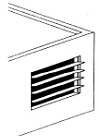
Openings are important elements for the regulation of the indoor climate. They should be large and fully openable, with inlets of a similar size on both sides of the room allowing a proper cross-ventilation. Windows shutters should be preferably equipped with flexible louvres allowing a regulation of ventilation. Door shutters may also incorporate louvres or grills. Windows with fixed glass panes are of no advantage and should be avoided.
To avoid direct solar radiation and glare, openings should be shaded by an overhangs, screens, lattices, grills etc.
All these measures have to be designed to give minimal resistance to the airflow.
Mosquito screens, which are essential in these regions, but reduce the airflow considerably, are therefore best installed away from windows, e.g. around the verandah or balcony.
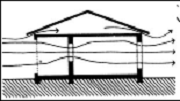
Openings should be placed according to the prevailing breezes, so as to permit a natural airflow through the internal space. This airflow is most effective if concentrated at body level.
Roofs
In warm-humid areas the roof should preferably be pitched. This makes it easier to achieve a construction which is waterproof by allowing heavy rains to run off.
Large overhangs protect the walls and openings from radiation and precipitation.
Additional Points
Although the intensity of radiation is normally less than in hot-dry regions, it is nevertheless a significant source of heat, and its entry into the building should be prevented. Tamil Nadu coast experiences diffused radiation that is not directional. Shading devices should therefore provide great coverage, obstructing most of the sky and not just the sun.
The proper arrangement of vegetation, mainly of shade-providing trees, within the surrounding space is an important aspect for the improvement of the indoor climate.
A common solution for warm-humid climates, like Tamil Nadu’s, is to grow green cover over roofs and walls. However, if not managed properly green cover attracts insects, and would even interrupt air flow.
Efficient air circulation is one of the few possibilities for natural climate control in warm-humid zones. Because of the minimal temperature differences it can hardly be utilized to cool down the building components, but cooling is felt through the increased perspiration of the human body.
However, this effect is only felt if the air is not fully saturated with humidity.
The flow of air can be influenced by topographical features, by the orientation of the building and by the position of surrounding buildings and other obstructions. Such obstructions may be built intentionally to divert the wind in a desired direction.
An exchange of air is also necessary because without it, both the temperature and the atmospheric humidity in the room will quickly increase above the values outside, due both to the heat and moisture output of human bodies and to various activities such as washing, cooking etc.